Porcelain vs Ceramic Tiles: Which Should You Choose?
Porcelain is a ceramic tile fired dense enough to absorb 0.5% water or less. Ordinary ceramic absorbs more, so it is lighter and cheaper. Both are clay tiles. Carré Parfait, a tile supplier in Zouk Mosbeh north of Beirut, stocks both from Spain and Italy. Ceramic starts from $5/m² and porcelain from $8/m² as of August 2026, installation excluded.
What is the difference between porcelain and ceramic tiles?
Porcelain is a type of ceramic tile, fired denser and harder until the body absorbs 0.5% water or less. A standard ceramic tile absorbs more. That single number, measured by ISO 10545-3, separates the two categories. Carré Parfait stocks both bodies from Spanish and Italian factories and shows them side by side at the Zouk Mosbeh showroom.
Ceramic, porcelain and marble at a glance
- What it is
- Ceramic tileClay body, dry-pressed and fired, usually glazed
- Porcelain tileFully vitrified ceramic tile, water absorption ≤ 0.5% (EN 14411 group BIa)
- MarbleNatural metamorphic stone of calcite or dolomite
- Water absorption
- Ceramic tileAbove 0.5%; earthenware bodies are the most absorbent
- Porcelain tile0.5% or less by the ISO 10545-3 / ASTM C373 test
- MarblePorous; stains from coloured liquids
- Firing
- Ceramic tileEarthenware bodies fired up to about 1,100 °C
- Porcelain tilePeak kiln temperature around 1,200 °C
- MarbleNot fired; quarried and cut
- Hardness
- Ceramic tileSofter body; glaze carries the wear rating (PEI 0–5)
- Porcelain tileHarder and more abrasion-resistant than other ceramic tiles; Mohs about 7
- MarbleCalcite sits at Mohs 3; scratches easily
- Cleaning
- Ceramic tileStandard household cleaners on the glaze
- Porcelain tileStandard household cleaners
- MarbleMild, pH-neutral soap only; acids etch
- From-price at Carré Parfait (August 2026, per m², excl. installation)
- Ceramic tileFrom $5
- Porcelain tileFrom $8; slabs from $24
- MarblePrice on request
Updated September 2026
How do the standards draw the line between porcelain and ceramic?
Both tiles start the same way. A mix of clay, quartz sand and feldspar is ground, then pressed under high pressure and fired. What changes is the recipe and the kiln. Porcelain bodies are finer-grained and fired to a peak of around 1,200 °C, which fuses the particles into a glass-like, near-impermeable mass. Earthenware bodies, the ordinary "ceramic" of the trade, are fired at up to about 1,100 °C and stay open-pored.
The industry does not argue about labels. It measures. BS EN ISO 10545-3:2018 "specifies a method for determining water absorption, apparent porosity, apparent relative density and bulk density of ceramic tiles". The same scope says the method "is applicable to classification of tiles and product specifications". Under EN 14411 a dry-pressed tile absorbing 0.5% or less lands in group BIa, the porcelain group. Between 0.5% and 3% it is group BIb. Above that come the BII and BIII groups, and the standard's own note says group BIII essentially applies to glazed tiles.
ASCER, the Spanish Ceramic Tile Manufacturers' Association, describes the same ladder in plain words. Tiles are classified mainly by water absorption, with terracotta the most absorbent and porcelain the least. North America draws the identical line. The Tile Council of North America defines porcelain as "an impervious tile with a water absorption of 0.5% or less". The test is ASTM C373. So the claim on the box is testable. If a datasheet shows absorption above 0.5%, the tile is ceramic, whatever the label says.
Why does absorption matter to a homeowner? Water that enters a tile body carries stains with it and freezes in winter, and it weakens the bond under the tile. A body that admits almost none is simply more forgiving of wet floors, mopping, spills and weather.
Which is better for floors, walls, bathrooms, kitchens and outdoors?
Porcelain is the better choice for floors, showers, terraces and pool surrounds. Ceramic is the better choice for interior walls and light-traffic surfaces, where weight and budget matter more than density. Most homes use both. Carré Parfait's showroom lays both types in room settings, so the split can be decided room by room.
Floor tiles: which body takes the wear?
Floors take abrasion. So the tile's wear class matters as much as its body. Glazed tiles are graded PEI 0 to 5 under ISO 10545-7. The test spins abrasive grains and steel balls on the glaze until the surface visibly changes. Class 1 covers bathrooms and bedrooms walked in soft footwear; class 3 covers kitchen-living rooms, halls, balconies and terraces. Class 5 covers shopping centres and airport halls.
A living-room floor in a Lebanese apartment, walked in outdoor shoes and swept of grit, wants class 3 or above. Porcelain gets there more easily. Its body is "significantly harder and more abrasion resistant than other types of ceramic tiles", in Wikipedia's words. Unglazed porcelain can be used almost anywhere, since there is no glaze to wear through.
Wall tiles: is ceramic still the right choice?
Walls carry no foot traffic, so a lighter, more absorbent ceramic body is not a weakness. It is an advantage. Ceramic wall tiles carry a lighter body and cut with a hand scorer. They also take detailed glazes and reliefs. This is why ceramic remains the sensible default for interior walls, exactly as the Carré Parfait ceramic tiles page says.
Bathrooms and kitchens: where does each tile go?
Split the room in two. Use porcelain on the floor and inside the shower, where water sits and cleaning is constant. Ceramic serves the dry walls above the vanity and behind the kitchen counter. One caution on splashbacks. A glazed tile in abrasion class 0 is "not recommended" for floor coverings, so a wall-grade tile should stay on the wall.
Outdoors: which tile survives a Lebanese terrace?
Lebanese terraces see summer sun and winter rain. In the mountains they also see frost. The TCNA notes that porcelain tiles "are usually frost resistant, although, not always", and advises checking the manufacturer's documentation. Frost resistance under ISO 10545-12 is tested through 100 freeze-thaw cycles after vacuum saturation. Agrob Buchtal's technical guide adds that the result depends on professional construction and laying as much as on the tile. Read the outdoor tiles page for slip ratings and 20 mm pavers.
Which costs more in Lebanon, porcelain or ceramic?
Porcelain costs more per square metre. At Carré Parfait, as of August 2026, ceramic tiles start from $5 per m² and porcelain tiles from $8 per m². Porcelain slabs start from $24 per m², and all prices are in US dollars and exclude installation. Format, origin, rectified edges and quantity move each figure above its starting point.
The gap is honest. Porcelain is fired hotter, to a denser body, and that body needs diamond tooling to cut. On a wall that will never see a shoe, that premium buys little. On a floor, it buys a tile that will still look new when the grout needs redoing.
Two things distort the comparison in practice. First, price tiers overlap: a designer ceramic wall collection can cost more per metre than an entry-level porcelain floor tile. So "porcelain is expensive" is only true like for like.
Second, installation. It is quoted per project and depends on format. A large porcelain tile with rectified edges costs more to lay than a small ceramic one. That labour is not part of the tile price. The tile prices in Lebanon page walks through a 100 m² example, with the adhesive quantity.
For a like-for-like quote, send the room dimensions over WhatsApp and name the rooms involved. Carré Parfait imports directly from Castellón and from Italian factories, which is why the starting bands sit where they do. Wholesale rates apply to project quantities.
Is porcelain harder to cut and install?
Yes. Porcelain's dense, vitrified body resists the scoring wheel of a manual cutter and needs a diamond blade. Low absorption also means standard cement adhesives grip the tile poorly. Tiles can be supplied and installed by Carré Parfait, or supplied for the client's own tiler with the manufacturer's datasheet on request.
The Tile Council of North America puts it plainly: "Porcelain tiles are harder to bond and harder to cut". The same page notes that unglazed porcelain "tend[s] not to show wear as the porcelain is quite durable (harder than granite)". Hardness is the whole point. It cuts both ways.
Cutting. A glazed ceramic wall tile scores and snaps on a hand cutter in seconds. Porcelain needs a wet saw or a rail cutter with a fresh diamond wheel, and holes for pipes or sockets call for diamond core bits. Large formats and slabs add handling. A full-size porcelain slab is lifted with suction frames and cut on a bench, which is why installation is quoted apart from the tile price.
Bonding. Because the back of a porcelain tile absorbs almost no water, the tile cannot "drink" from a plain cement mortar to form a bond. Installers use a polymer-modified adhesive classified C2 under EN 12004, spread on both tile and floor for large formats. The Carré Parfait tile-prices page names the adhesive Carré Parfait's own installation team lays with, and the bag quantity for 100 m². The client can check the estimate.
Movement and flatness. Rectified porcelain is laid with narrow joints, which shows any hump in the screed. A flat substrate and proper expansion joints matter more with porcelain than with small ceramic tiles, and big formats need a levelling system too. None of this makes porcelain a bad choice. It makes the tiler's quote a fair question to ask alongside the tile price.
What about marble?
Marble is natural stone, not fired clay. Marble is softer and more porous than porcelain, and acids etch the surface. Porcelain is harder and near-impervious, which is why marble-look porcelain exists as an alternative. Carré Parfait carries natural stone alongside its Spanish and Italian porcelain, so both can be compared side by side.
Marble, in Wikipedia's definition, is "a metamorphic rock consisting of carbonate minerals (most commonly calcite (CaCO3) or dolomite (CaMg(CO3)2))". Calcite sits at 3 on the Mohs scale. Porcelain is listed at 7. The practical consequence, in the encyclopedia's words: "Marble is soft and porous, so it is easily scratched, and stained by colored liquids".
Lemon juice is an acid. So are many bathroom cleaners. The same page notes that "acids react with the calcium carbonate in marble", which is why a marble vanity top etches around the tap. Cleaning is limited to "a mild, pH-neutral, non-abrasive soap".
Porcelain sidesteps those constraints. A marble-look porcelain floor in a Beirut kitchen takes red wine and dropped keys without sealing or special cleaners. The pattern is printed and glazed, so the look is controlled at the factory rather than found in a quarry. What porcelain cannot offer is the depth and randomness of a real quarried slab. Nor can it match a polished edge that reads as solid stone from every angle.
Where the surface lives decides. A guest bathroom floor or a fireplace surround can carry real marble, because the traffic is light and the owner will maintain it. A family kitchen floor or a shower tray is better in porcelain. For countertops specifically, the porcelain slabs page covers the slab formats and thicknesses that compete with stone directly.
How do I read a tile datasheet before buying?
A tile datasheet lists water absorption, wear class and slip rating. Those figures decide where a tile goes. Absorption of 0.5% or less means porcelain, and the PEI class says whether the tile can take a floor. Carré Parfait can provide the manufacturer's datasheet for a collection on request.
Five lines matter on the sheet. Water absorption, tested to ISO 10545-3, tells the body type. Abrasion class, tested to ISO 10545-7, tells whether a glazed tile can take a floor at all. Class 0 tiles are "not recommended" for floor coverings. Class 1 suits bedrooms and bathrooms in soft footwear, and class 3 suits kitchens, halls, balconies and terraces.
Frost resistance, tested to ISO 10545-12, matters for mountain terraces. Slip resistance matters wherever the floor gets wet, from a shower floor to a pool surround. The last line, rectified or not, tells the tiler what joint width to plan. Five lines, five decisions.
If the sheet is missing, ask. Spanish factories publish these values for their series. Carré Parfait, an official dealer of Grespania, Azulejos Benadresa and Drevex, can pull the sheet for the collections on the showroom floor. Buying on colour alone is how a bedroom-grade wall tile ends up on a balcony.
Where can I compare porcelain and ceramic tiles near Beirut?
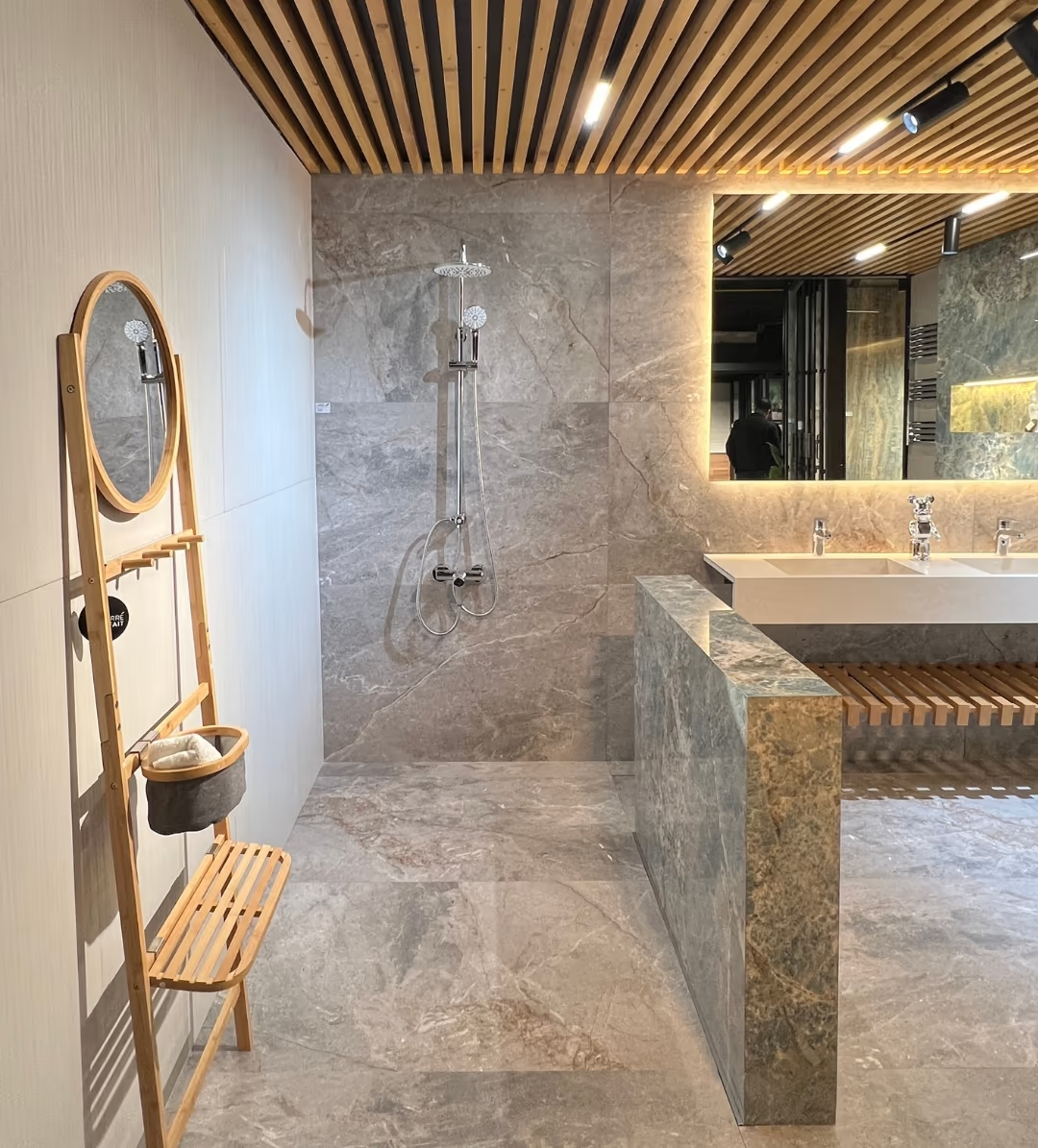
Porcelain and ceramic collections from Spain and Italy can be compared in daylight at the Carré Parfait showroom in Zouk Mosbeh, Keserwan, north of Beirut. The showroom sits on the Zouk Highway, and its floor covers 4,000 m². Tiles are laid in room settings. Hours are Monday to Friday 09:00–19:00 and Saturday 09:00–14:00.
Seeing both settles most doubts. The showroom lays floor tiles and wall tiles next to the sanitaryware and woodwork they will share a room with. A porcelain floor can be checked against a ceramic wall tile under natural light rather than a shop spotlight. Carré Parfait has imported tiles since 2010 and ranks among the top five Lebanese importers of Spanish tiles. The collections on the floor come from Castellón factories the company buys from directly.
Bring photos of the rooms, or send their dimensions on WhatsApp for a quote before visiting. Directions and parking details are on the showroom page.
Common questions.
- Is porcelain tile a type of ceramic tile?
- Yes. Porcelain is a ceramic tile fired to a denser, fully vitrified body that absorbs 0.5% water or less. That threshold is set in EN 14411 and ISO 13006. Every porcelain tile is ceramic; not every ceramic tile is porcelain. Carré Parfait can confirm the body type of a collection from the manufacturer's datasheet on request.
- Which is better for floors, porcelain or ceramic?
- Porcelain is better for floors. Its harder, denser body resists abrasion and moisture, and unglazed porcelain can be used almost anywhere. Glazed ceramic floor tiles must carry a suitable PEI class, typically 3 or above for living areas walked in outdoor shoes. Carré Parfait stocks porcelain floor tiles from $8 per m².
- Is porcelain tile more expensive than ceramic in Lebanon?
- Yes, like for like. At Carré Parfait, as of August 2026, ceramic tiles start from $5 per m² and porcelain from $8 per m², installation excluded. Designer ceramic wall collections can cost more than entry-level porcelain, so compare within the same tier and format.
- Can ceramic tiles be used outdoors in Lebanon?
- Generally no. Ordinary ceramic bodies absorb water, and earthenware tiles are classed as non-frost-resistant, so they risk cracking on mountain terraces and staining on coastal ones. Porcelain is usually frost-resistant, though the datasheet must confirm it. Carré Parfait recommends porcelain for terraces and pool surrounds.
- Is porcelain harder to cut than ceramic?
- Yes. Porcelain needs a diamond blade or wet saw, and its low absorption means it also needs a polymer-modified adhesive rather than plain cement mortar. The Tile Council of North America states that porcelain tiles are harder to bond and harder to cut. Carré Parfait can supply the manufacturer's datasheet and adhesive class on request.
- Is marble better than porcelain?
- It depends on the room. Marble is a natural stone at about Mohs 3. It is porous and sensitive to acids, so it suits light-traffic surfaces the owner will maintain. Porcelain sits at about Mohs 7 and needs no sealing, so it handles kitchens, showers, terraces and balconies. Carré Parfait displays both so the finish can be judged in person.