Porcelain Slabs in Lebanon — 120×260 to 160×320 cm, from $24/m²
Porcelain slabs in Lebanon start from $24 per m² at Carré Parfait, a tile supplier in Zouk Mosbeh, north of Beirut. US dollars, as of August 2026, tiles only. The slabs are Grespania's Coverlam line from Spain, from 100×300 up to 162×324 cm and 3.5 to 20 mm thick. Each stands at real scale. The showroom floor covers 4,000 m².
What are porcelain slabs?
Porcelain slabs are porcelain tiles of one square metre or larger, pressed at 3.5 to 20 mm and fired to under 0.5 per cent water absorption. A slab is fired ceramic, not stone. Carré Parfait in Zouk Mosbeh, Lebanon, supplies Grespania's Coverlam slabs from Spain, from 100×300 cm to 162×324 cm, for walls, floors, countertops and facades.
Porcelain slab options at Carré Parfait (Grespania Coverlam, Spain)
- 3.5 mm
- Formats (cm)100×300 · 120×260 · 120×278 · 120×360 · 162×324
- Where it goesInterior walls, shower walls, facades, furniture and door fronts
- Tiles-only from-priceFrom $24/m² (August 2026), tiles only
- 5.6 mm
- Formats (cm)120×278, plus 120×120 and 60×120 companions
- Where it goesFloors and walls in homes, lobbies and shops
- Tiles-only from-priceFrom $24/m² (August 2026), tiles only
- 12 mm
- Formats (cm)162×324 (Coverlam Top)
- Where it goesKitchen and bathroom countertops, sinks, furniture
- Tiles-only from-priceFrom $24/m²; countertops from the cut plan
- 20 mm
- Formats (cm)162×324 (Coverlam Top)
- Where it goesCountertops with a thick visible edge; heavy-duty floors
- Tiles-only from-priceFrom $24/m²; countertops from the cut plan
Updated September 2026
What separates a porcelain slab from a large tile?
The word "slab" is borrowed from stone. A porcelain slab is a fired ceramic panel, not a cut piece of quarry rock. The body is the same dense, vitrified material as a good porcelain floor tile. Wikipedia defines porcelain tiles as "dense, vitrified ceramic tiles characterised by a water absorption less 0.5 per cent". They are fired in roller kilns at peak temperatures around 1,200 °C. The standards behind that number are ISO 13006 and BS EN 14411.
What changes with a slab is scale. The same article notes that modern porcelain formats can reach 1,600×3,200 mm, with specialist factories going further. In North America the material has its own standard, ANSI A137.3. It defines "gauged" as "manufactured to a thickness that is specific and largely associated with installation and use". The same standard draws the line at which a tile becomes a panel or slab: "one square meter in facial area or larger". A 60×120 floor tile is 0.72 m². A 120×260 Coverlam panel is 3.12 m², so one piece faces a whole shower wall.
Thin gauge is the other half. In Grespania's own words, Coverlam is a "large format technical porcelain surface with reduced thickness". It is made for "interior and exterior cladding and flooring, facades, countertops and furniture". At 3.5 mm the panel bonds to furniture fronts and facades. Those are the two places where stone weight rules stone out.
One naming caution. Carré Parfait also manufactures a washbasin range called the Slab Collection, at its own factory sites in Zouk Mosbeh and Safra. Those are basins, priced from $295 as of September 2026. This page is about the tile format.
How much do porcelain slabs cost in Lebanon?
Porcelain slabs at Carré Parfait in Zouk Mosbeh cost from $24 per square metre, in US dollars as of August 2026, tiles only. Installation is extra. That is 3 times the $8 porcelain-tile entry price on the same floor. Countertop slabs are quoted from the cut plan once the format and substrate are known.
The gap between an ordinary porcelain tile and a slab is the format, not the material. A slab needs a bigger press and a fibre-mesh backing on the thin gauges. It needs crating that keeps a 3.24-metre panel flat in transit, and two people plus a frame to move it from truck to wall. All of that sits inside the price.
A worked example, tiles only. A 10 m² feature wall in slab is 10 × $24 = $240 at the band entry, before cutting allowance. The same wall in 60×120 porcelain starts at 10 × $8 = $80. The slab wall gets one or two joints. The tiled wall gets thirty. That is what the difference buys.
Four things move a quote above $24. The collection tier first, because each series sits at its own point in the band and the exact figure is confirmed per collection. Thickness second, because 12 and 20 mm Coverlam Top slabs carry more material and are cut and edge-finished for countertops. Quantity third, since wholesale rates apply to project volumes. Cutting waste fourth, since a countertop L-shape or a wall with a window rarely divides evenly into 162×324 panels, and the offcut is paid for.
Two lines are missing on purpose. There is no installed price. Slab installation depends on substrate flatness and the access route to the room, so Carré Parfait quotes it per project. There is no upper bound, because Carré Parfait publishes starting prices, not ranges. For a quote, send the drawings or the room dimensions on WhatsApp and the number comes back on the real quantity. Full context for the ceramic and porcelain bands is on the tile prices page.
Which sizes and thicknesses of porcelain slab exist?
Grespania's large-format catalogue, supplied in Lebanon by Carré Parfait, lists 100×300, 120×260, 120×278, 120×360, 160×320 and 162×324 cm formats. The Coverlam line is documented at 3.5, 5.6, 10.5, 12 and 20 mm. Gauge follows the job. The 3.5 mm gauge is a wall and facade product; 5.6 mm goes on floors; 12 and 20 mm are for countertops.
The format list comes straight from Grespania's large-format catalogue page, which filters by exactly those sizes. Trade press covering the 2023 range confirms the Coverlam pairing. The 3.5 mm gauge runs across 1200×3600, 1620×3240, 1000×3000, 1200×2780 and 1200×2600 mm. The 5.6 mm Surface series comes in 1200×2780 mm, with 1200×1200 and 600×1200 companions. The Top versions for kitchen countertops are 12 and 20 mm, in 1620×3240 mm. Each gauge has its formats.
Which thickness for which job is not a matter of taste. ANSI A137.3, the gauged-porcelain standard published by the Tile Council of North America, sets separate strength tables by gauge. Products of 3.5 to 4.9 mm get "Wall and countertop strength criteria". Products of 5.0 to 6.5 mm get "Floor, wall, and countertop strength criteria", and a third table covers 20 mm and above. Read plainly, a 3.5 mm slab belongs on a wall or, bonded to a substrate, a countertop. Floors take 5.6 mm or thicker.
On the European side, Coverlam received European Technical Assessment ETA 24/0747 in April 2026 as a cladding material for facades and flooring. In Grespania's words, it "covers Coverlam with mesh in the following thicknesses: 3.5 mm · 5.6 mm · 10.5 mm · 12 mm · 20 mm". For a specifier that matters. The facade gauge has a third-party document behind it.
A practical note on the 162×324 format. A 162×324 slab does not pass through every stairwell in a Beirut apartment building. Before falling in love with a format, measure the lift, the door, the corridor turn and the stairwell landing. Bring those dimensions to the showroom; they sometimes change the format from 162×324 to 120×260 before anything is ordered.
Where are porcelain slabs used: floors, walls, countertops, facades?
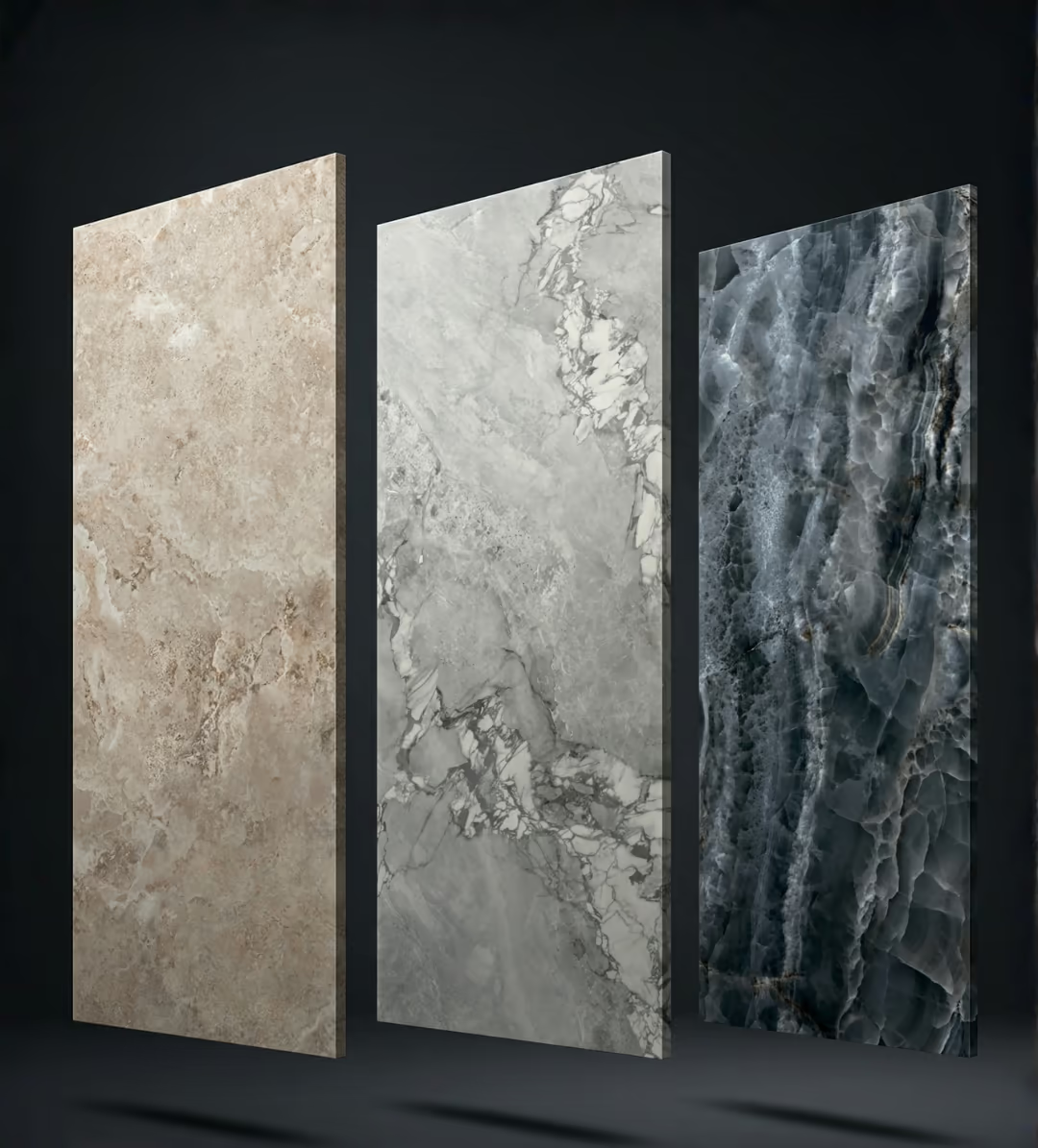
Porcelain slabs are used on interior floors and walls, shower and bathroom walls, kitchen and bathroom countertops, ventilated facades and furniture fronts. Carré Parfait in Zouk Mosbeh supplies Grespania Coverlam for all five uses. The panels stand at real scale on the showroom floor, so the joint-free effect is judged at full size. Five uses, one material.
Walls are the usual starting point. A bathroom wall in 120×260 slab has no grout lines at eye level, which reads as stone without the maintenance of stone. The 3.5 mm gauge adds almost nothing to the wall build-up. Shower walls are the classic case: one panel, no joints for water to find.
Floors take the 5.6 mm gauge or thicker, per the ANSI strength tables above. Living rooms, hotel lobbies, corridors and shop floors are the typical rooms. The 5.6 mm Coverlam series is offered with matching 120×120 and 60×120 pieces. So a slab floor can turn into a stair or a corridor in the same material. Nothing visibly changes.
Countertops are the reason the 12 and 20 mm gauges exist. Grespania's Coverlam Top page lists kitchen countertops, bathroom countertops, sinks and furniture as its applications. The 20 mm version gives a thick visible edge without mitring. The 12 mm version is mitred to fake a thicker edge, or bonded to a substrate. Two gauges, two edge details.
Facades are the professional end. Grespania describes Coverlam as "unalterable to heat, ice and chemical agents" and suitable for "interior and exterior cladding and flooring, facades". The 2026 ETA assessment covers exactly that use. On the coast between Beirut and Jounieh, salt air and summer sun are the enemies of painted render. A fired porcelain skin does not fade or chalk.
Furniture is the quiet fifth use. A 3.5 mm panel bonded to a door or a vanity front gives a stone look at a fraction of the weight. Carré Parfait manufactures made-to-measure vanity units, so a vanity can be sized to a slab countertop rather than the other way round.
Porcelain slabs vs marble: which is better for a kitchen countertop?
For a kitchen countertop, a porcelain slab outperforms marble on stains, acids, heat and scratches. Marble wins on depth of natural veining and on resale of the word "marble". Carré Parfait in Zouk Mosbeh displays both. Carré Parfait recommends porcelain for a kitchen that is cooked in daily, and marble for a bathroom vanity or a guest space.
The case against marble in a kitchen is chemistry. Marble is a metamorphic rock of calcium carbonate. Wikipedia's article is blunt about the consequence: "Marble is soft and porous, so it is easily scratched, and stained by colored liquids". It adds that "Marble surfaces are corroded by alcohol or acidic liquids". Lemon, vinegar, wine and tomato are all acids. Each one etches a dull spot that no cleaning removes. A Lebanese kitchen runs on lemon.
Porcelain has no calcium carbonate to attack. A slab is vitrified ceramic with water absorption below 0.5 per cent. Grespania's countertop page states that Coverlam Top's "low porosity prevents water absorption". It "withstands friction, cuts and impacts without being altered by daily use". On heat: "It tolerates high temperatures without damage, even direct contact with hot utensils". Cleaning is "soap and water". Those are the manufacturer's words, not a showroom's.
Marble keeps two advantages. Its veining runs through the block, so a polished edge shows the same figure as the face. A porcelain slab's pattern is printed and fired onto the surface, so a cut edge is body colour unless it is mitred. And marble is cold to the hand in a way porcelain imitates but does not quite match.
One practical difference decides many kitchens. Repair. A chipped porcelain edge is harder to fill invisibly than a chipped marble edge. So a 20 mm slab with a rounded or chamfered edge is the safer detail in a family kitchen.
The honest summary for Lebanon is short. Porcelain for the kitchen you cook in; marble for the room you want to impress in. Both stand on the Zouk Highway floor. There, marble, onyx, travertine and porcelain slabs can be compared side by side in daylight.
What are the pros and cons of porcelain slabs?
Porcelain slabs bring near joint-free walls, a stone look at low weight, stain and heat resistance, and a fired surface that does not fade outdoors. Against them: a higher per-square-metre price than tile, handling that needs planning, a printed rather than through-body pattern, and installation that demands a flat substrate. Carré Parfait quotes from the drawings.
The advantages are already on this page, with sources. Absorption below 0.5 per cent, a manufacturer statement of resistance to heat, ice and chemicals, and a third-party facade assessment. Add hygiene. No grout means nowhere for mould to sit in a shower. A countertop with one joint is easier to keep clean than a tiled one with two hundred.
The drawbacks deserve equal space. Price first, from $24 per m² against $8 for porcelain tile at Carré Parfait, before cutting waste. Handling second: a 162×324 panel is fragile in transit until it is bonded, and it needs a suction frame and two trained people. Substrate third: a 3.5 mm panel telegraphs every bump in the wall behind it, so the plaster must be flat before the slab arrives. Edges fourth: the printed surface means an exposed cut edge is body-coloured, and mitring costs money. And an outdoor slab floor needs the floor gauge the strength tables call for, not the 3.5 mm wall gauge.
Buyers who plan for those four points rarely regret the format. Buyers who treat a slab like a big tile, ordered by the box and laid by a crew that has never handled one, do. That crew matters. Slabs can be supplied and installed by Carré Parfait; its own installation team quotes the work per project.
Who supplies porcelain slabs in Lebanon?
Carré Parfait supplies porcelain slabs in Lebanon from its 4,000 m² showroom in Zouk Mosbeh, Keserwan, north of Beirut, as an official dealer of Grespania. Grespania's Coverlam line leads the range. Slabs are imported directly from Spain and selected by Carré Parfait's own Castellón office. Slabs can be supplied and installed by Carré Parfait.
The Spanish origin is not incidental. Castellón province makes about 94 per cent of Spain's ceramic tiles, according to ASCER, the Spanish ceramic tile manufacturers' association. The same body reports 423 million square metres produced in 2025, with 72 per cent of turnover exported to almost 190 countries. Grespania is a Spanish house. Carré Parfait Spain, the company's own office in Castellón, selects the collections at the factory and manages export. Carré Parfait ranks among the top five Lebanese importers of Spanish tiles.
What does that mean for a slab buyer in Beirut, Jounieh, Kaslik or Adonis? The panels standing at the showroom are ordered in the same formats and thicknesses Grespania publishes. Project quantities use the same channel. The showroom is on the Zouk Highway, with parking. Hours are Monday to Friday 09:00–19:00 and Saturday 09:00–14:00. The slabs stand at real scale alongside the VitrA bathroom settings.
For a quotation, send the room drawings or the countertop template on WhatsApp at +961 79 311 101. Published project references include the Rotana Arjaan in Iraq (tiles and slabs) and Rotana Erbil (tiles). Magma Square in Sulaymaniyah and Amelia Faraya in Lebanon were tiles and sanitaryware; voco Beirut was sanitaryware.
Common questions.
- Are porcelain slabs the same as large-format tiles?
- Yes in body, different in scale. The trade calls porcelain of one square metre or larger a panel or slab, per ANSI A137.3, and Wikipedia records formats up to 1,600×3,200 mm. Carré Parfait supplies Grespania Coverlam from 100×300 to 162×324 cm; a 60×120 tile is a large tile, not a slab.
- Can a porcelain slab be used as a kitchen countertop in Lebanon?
- Yes. Grespania's Coverlam Top slabs at 12 and 20 mm are made for kitchen and bathroom countertops. The manufacturer states they tolerate direct contact with hot utensils and clean with soap and water. Carré Parfait in Zouk Mosbeh quotes countertops from the cut plan; send the template on WhatsApp.
- What is the price per square metre of porcelain slabs in Lebanon?
- Porcelain slabs at Carré Parfait start from $24 per square metre, in US dollars as of August 2026, tiles only. Standard porcelain tile starts at $8. Collection tier, thickness, quantity and cutting waste move the figure above that entry point. Installation is quoted separately per project once the substrate is known.
- Which thickness of slab goes on a floor?
- Use 5.6 mm or thicker on floors. ANSI A137.3 sets floor strength criteria for gauged porcelain of 5.0 to 6.5 mm and for 20 mm and above. For 3.5 to 4.9 mm the standard sets wall and countertop criteria only. Carré Parfait supplies the 5.6 mm Coverlam gauge for floors and keeps 3.5 mm for walls and facades.
- Does Carré Parfait install porcelain slabs?
- Yes. Slabs can be supplied and installed by Carré Parfait, and its own installation team quotes the work. A 3.5 mm panel needs a flat substrate, a suction frame, a full adhesive bed and trained hands. Installation is priced per project after the format and the access route to the room are known.
- Is the Slab Collection the same product as porcelain slab tiles?
- No. The Slab Collection is Carré Parfait's range of handcrafted porcelain washbasins, made at its own factory sites in Zouk Mosbeh and Safra. Prices start at $295 as of September 2026. This page covers porcelain slab tiles from Grespania in Spain. The two share a word, not a factory.